

Table of Contents
Like our content?
Prefer us on Google.
Add as preferred Prefer us on Google.
source on Google
Want Better Project Time and Cost Insights?
Save 20% per month
20+ integrations
Permissions and customization



Time tracking for contractors is crucial in today’s gig economy landscape. While staffing your company entirely with independent contractors might sound tempting, it comes with challenges and obligations. The growing distributed economy is increasingly regulated to protect these workers. It’s important to understand the costs, benefits, and obligations of using contractors and freelance workers, particularly if you plan to use an independent contractor time tracking tool.
With no need to pay taxes, overhead, or benefits, it’s no wonder companies prefer to cut costs and hire independent contractors. They now make up nearly half of workers at most technology firms, and in the United States these companies can save $100,000 a year per worker by using contractors in place of full-time employees. What’s not to love?
TL;DR: What you’ll learn
Working with independent contractors comes with real upside — and real legal and operational risk if time and costs aren’t tracked correctly. This post breaks down the legal line between employee and contractor, the day-to-day challenges of managing a mixed workforce, and how the right time tracking tool keeps everything compliant, accountable, and easy to bill.
Here’s what this article covers:
- What actually makes someone a contractor, not an employee: The legal tests regulators and courts use, and why misclassification is a costly, increasingly litigated risk
- The operational headaches of managing a mixed workforce: Coordinating tasks, timelines, and performance across employees and contractors without losing visibility or letting costs run over
- Why compliant time tracking isn’t optional: How rulings like the EU’s mandatory time tracking directive raise the bar for what “legally compliant” contractor timekeeping looks like
- How to simplify contractor time tracking day to day: Flexible time entry, billing rates by worker or project, and mobile access that keeps records accurate without adding admin work
- What to look for in a time tracking tool: From user roles and bulk approvals to exportable reports and automated invoicing, illustrated with how real companies use Beebole to manage contractors, control costs, and get paid accurately
When is someone an employee and when are they a contractor?
While laws vary by country or state, generally speaking, labor laws concerning minimum wage, overtime pay, withholding obligations, workers’ compensation and so forth all hinge on whether or not an individual is an employee or an independent contractor. These added responsibilities and costs make it tempting for companies to misclassify workers, and there is constant litigation on the issue.
It’s important to remember that the determining factor as to whether a worker is an employee is not simply the label an employer uses. An individual does not become an independent contractor under the law just because their employer chooses to classify them as such. Generally, the pertinent laws will set out a multi-part test that determines a worker’s classification. Take a look at your region’s laws to ensure your contract jobs are compliant.
Can a company be an independent contractor?
You might also be wondering if a company itself can be designated as an independent contractor. In short, no, a company can’t be considered an independent contractor. Remember, an independent contractor is someone who offers their services to the general public, and that person gets to decide what work to do and when to do it.
If you think of a company as a legal entity that can be structured in various ways—nonprofits, corporations, LLCs, S corporations, sole proprietorships, and more—then the distinction should be clear. Only people can be classified as independent contractors.
Note that an independent contractor might make the decision to create a sole proprietorship, which is a one-person business that’s not registered as either a corporation or an LLC. Sole proprietors are responsible for paying both income taxes and business debts, and they can also be held personally liable for any business obligation.
Whether operating as an independent contractor or a sole proprietor, tracking time on tasks, projects, and clients is absolutely key to understanding where your time goes, pinpointing top clients, and following through with accurate invoicing and billing.
With a team that shifts between 20–30 consultants at any given time, Dashe & Thomson needed a smarter way to track hours, budgets, and project margins. Their outdated timesheet tool was clunky and slowing everyone down — until they switched to Beebole.
Now they:
⚡Save hours of admin time every month with streamlined setup and reminders
📊 Get instant visibility into consultants, tasks, budgets, and project status
✅ Ensure accurate invoicing and protect against disputes or audits
🚀 Focus on strategy, not firefighting, with real-time insights into profitability
Are you missing the clarity and savings Dashe & Thomson unlocked with Beebole?
The challenges for companies of managing a workforce of contractors
If you are confident that your independent contractors are correctly classified in your organization, great. But there are a number of other ongoing challenges and risks to hiring freelance workers. Aside from liability issues and compliance with ever-changing regulations, day-to-day management requires patience, communication, and clarity. Without them, you’ll end up with missed deadlines, unclear expectations, and frustration on both ends.
Some typical challenges of managing a workforce with contractors are lack of oversight, difficulty in coordination of tasks and timelines, and inconsistent performance. Beebole’s resource planning addresses this directly: Kanban and Gantt views give managers real-time visibility into workload and capacity, so tasks get matched to the right person based on skills and availability instead of guesswork.
However, from our perspective, the riskiest of the challenges is keeping project cost overruns under control. Unexpected delays or scope changes can lead to cost overruns, impacting your operations and finance teams, and their project budgets. To get ahead of this, consider implementing a real-time tracking method. Beebole’s project financials reporting, for example, includes real-time budget burn indicators that flag over-budget trends before they escalate, so finance and ops teams can step in before a small overrun becomes a big one. Many of the customers who opted to sign up for a tool like Beebole told us their reason was to keep track of billable hours to avoid further underestimation of project costs, which was leading them to financial losses.
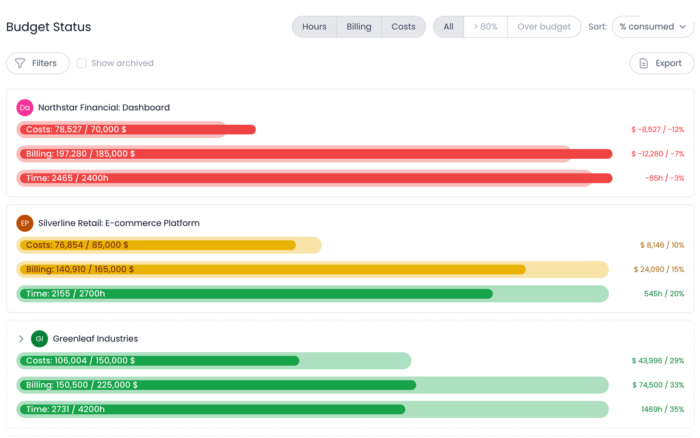
Beebole allows us to clearly track the hours per employee, contractor, and vendor within each individual project, to set deliveries, control budgets, and analyse project margins.
Indeed, effective contractor management and time tracking will help with a number of these issues. However, some contractors will be resistant to using a tracking tool. Oftentimes, this opposition stems from concerns about privacy and ease of use. Companies must weigh the costs and benefits of using tools that take screenshots or track location and keystrokes (intrusive features that Beebole doesn’t offer). It is also helpful to inform workers and assure them that their information will be safe. If you require independent contractors to use a tool, they have a right to understand how it works.
Reminder: Ensuring your time tracking software for contractors is legally compliant
You may have never stopped to consider whether or not your company’s timekeeping for contractors is actually legally compliant. First, bear in mind that it is not technically legal to schedule independent contractors. You can negotiate bids and reach agreements about timing and deadlines, but you may not dictate the working hours of a contractor. It is, of course, permissible to pay freelancers by the hour and to track that time. However, the way time is tracked may also be regulated.
Many countries already have time tracking or employee monitoring legislation on the books. It should also be noted that this often includes time tracking for remote teams. Most recently, the Court of Justice of the European Union ruled to make employee time tracking mandatory in all member states. It’s difficult to say if the ruling applies to timesheets for independent contractors, as the specifics are left up to each nation. Employers should keep an eye out for new and relevant legislation in the coming years.
Whatever the requirement in your jurisdiction, Beebole’s audit trail keeps a timestamped record of every entry and edit, so if a regulator or auditor ever asks how contractor hours were tracked, you already have a verifiable answer.
Simplifying independent contractor time tracking
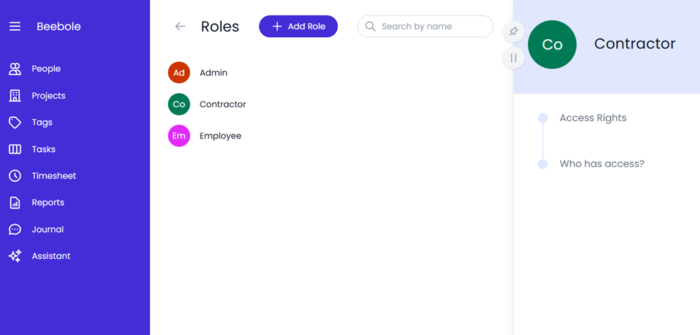
When it comes to ease of use, features like automated reminders, an intuitive interface, and flexible mobile time tracking all help. Beebole offers all of these features, and a mobile app that syncs automatically and works offline, for easy time tracking anywhere. Time entry may be done by manually entering a start and end time, using a timer, dragging on a calendar, using AI-suggested entries, or filling in a weekly timesheet grid. Contractors can submit hours for approval, including comments about the work. Finally, as we mentioned above when adding a worker to Beebole, you may categorize them as an employee or a contractor, and configure that particular role’s permissions accordingly.
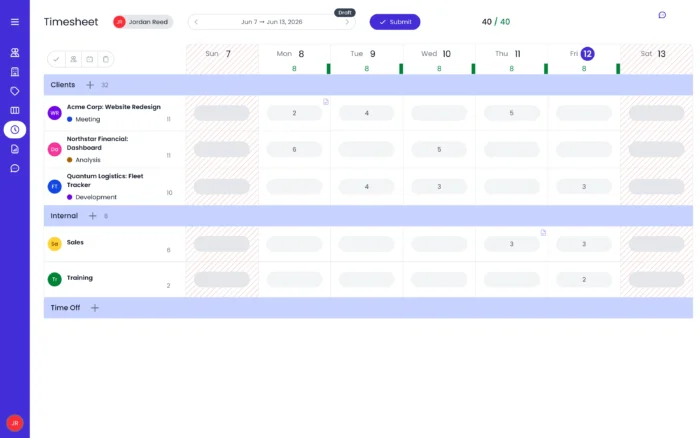
Given the nature of their work, independent contractors usually care most about reports on hours worked, billing, and invoices. Beebole’s customizable reports cover time spent, budgets, and margins in one place — managers can build multidimensional views, save them as templates, schedule them for automatic delivery, and assign them to specific types of users based on permissions. You can distinguish between billable and non-billable time, and set billing rates at the organization, tag, project, and person levels to ensure accurate invoicing. Beebole’s project financials also separate cost rates from billing rates for a clear view of margins, and contractor payments and pay reports stay simple: export and share professional invoices, or sync with your accounting software to bill confidently.
While absences are usually irrelevant for contractors, it is important to manage their availability. With Beebole, you can set up customizable time-off types — vacation, illness, or any category you define — so contractors can log planned time away and route it for approval, with those absences syncing automatically into resource planning to keep capacity views accurate. These seemingly simple capabilities can make a big difference when managing contractors. When freelancers can count on reliable client reporting and accurate hours, and feel confident they will get paid fairly, it’s a win-win for all parties.
Why companies use Beebole for contractor time tracking
- Mobile app with offline mode for iOS and Android that works on all devices
- Create user roles to filter reports and configure permissions for contractors
- Tag people by role type (contractors, employees, project managers, etc.)
- The simple interface means you’ll save time onboarding
- Quickly approve, reject, and lock hours in bulk
- Set costs and billing rates at the organization, tag, project, or person level
- Send automated reminders
- Time off tracking to make availability clear
- Exportable, sharable, and saveable reports on time, costs, billing, and more
- Create personalized and professional invoices
Companies in more than 60 countries are already using Beebole to track independent contractor time (here’s a real example of time tracking for IT consultants). They range from freelancers to multinationals across sectors like marketing, construction, banking, civil engineering, design, and much more.
This is a really useful product for keeping track of time spent per client and billing accordingly. It also ensures work undertaken is accurately recorded and not forgotten when it comes to billing.
My biggest challenge was making sure that my subcontractors were paid the correct amount in the current currency. With Beebole it was easy and painless to standardize on one procedure. It has all the functionality that I need to deal with employees, contractors, variable costs and billing rates, variable currencies, and more.
For contractors billing across currencies like Paul’s, Beebole’s native QuickBooks Online and Xero integrations sync payment data straight into your accounting software, so multi-currency invoicing stays accurate without manual re-entry.
Enhanced accountability and cost control: time tracking for contractors
In the short term, your motivation for tracking contractor time may be solely about billing.
In the long term, purposeful and well-organized time tracking will generate numerous other benefits for your business. Having a clear overview of contractors’ availability, project status, and budgeting makes for more efficient management and resource allocation. While you don’t necessarily need to calculate the cost of an employee in this particular case, understanding what’s spent on independent contractors vs. what’s delivered is key. Beebole’s project financials separate cost rate from billing rate, so you can see true margin on every contractor engagement — not just top-line billing.
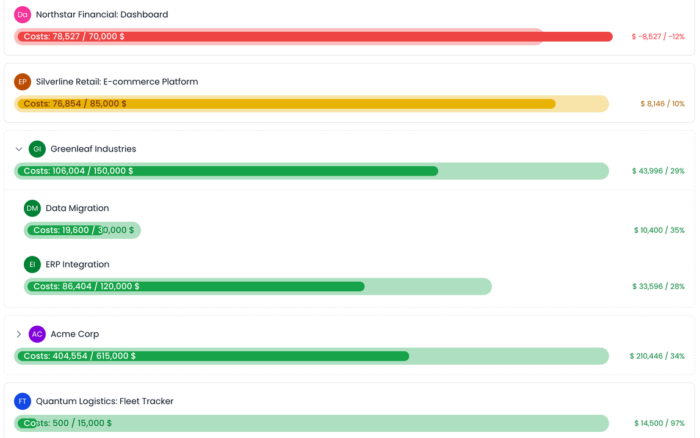
What’s more, having an accurate record of contract time can be invaluable in the case of an audit or dispute. The business intelligence and peace of mind you’ll gain with tools made for independent contractor time tracking like Beebole will allow you to focus on long-term strategy and growing your business.
Better Manage Your Contractor Workforce
—
Photo by Leon Seibert on Unsplash

Managing Inbound and Customer Success at Beebole. Connecting with teams and managers worldwide, identifying their obstacles, and communicating the creative solutions that Beebole can offer. Working remote from the Canary Islands.
Comments
Related posts

“Automation for finance and accounting is a must.” An interview with Packlink’s CFO.
For Noelia Podadera, Chief Financial Officer at Packlink, big data and automation for finance are keys to competing in the high-growth delivery industry. She shares these and other insights in this instalment of The CFO Journal, a series featuring financial leaders from around the world. Who is Noelia Podadera? Where: Packlink is an online shipping […]

DCAA compliant time tracking: Everything you need to know
So, what does it mean to choose a DCAA compliant time tracking tool? The most simple answer is that for an organization to remain compliant, its timekeeping processes and software must also follow a certain set of guidelines. We’ll get into those details below. Being DCAA compliant means fulfilling a considerable list of requirements, most […]
Actual, planned, and earned time explained (with examples & best practices)
In project time tracking, it’s crucial to understand the difference between actual time, planned time, and earned time. Think of these three metrics as lanes in a swimming pool — each moving you forward, but at a different pace and with a different story to tell about your project’s progress. On their own, they can […]
Fantastic insights on time tracking for independent contractors! Your blog provides a thorough understanding of its importance and practical tips for effective implementation. I appreciate the clarity and real-world examples that make it easy for independent contractors to optimize their time management. Thanks for sharing such valuable information!