

Table of Contents
Like our content?
Prefer us on Google.
Add as preferred Prefer us on Google.
source on Google
Beebole is a key staple of our back office operations.

In today’s fast-paced business environment, the difference between organizations that thrive and those that merely survive isn’t found in their ability to avoid failure—it’s in their capacity to learn from it. That’s why we’re tackling project post-mortems and everything you need to know to conduct them successfully.
TL;DR: What you’ll learn
Post-mortems have evolved from blame-heavy autopsies into structured learning systems that top teams use to turn failure into forward progress. Here’s what we’ll cover today:
- Modern post-mortems: How they differ from classic “lessons learned,” and why blameless, cross-team learning is now the standard
- How the methods compare: Where project post-mortems, incident reviews, and agile retrospectives overlap, and where each is the better tool
- When to use each approach: Matching the right review type to Waterfall, Agile, or hybrid/DevOps workflows
- How Google and J.M. Huber do it: Real examples of blameless, repeatable post-mortem programs at scale
- A step-by-step framework: How to run your own post-mortem before, during, and after the meeting, plus the questions that surface real root causes
- How to make lessons stick: Turning insights into checklists and templates instead of letting them gather dust, with a free downloadable checklist and a look at using time tracking data (like Beebole’s) to ground the analysis in facts, not guesswork
What is a modern project post-mortem?
A project post-mortem is an organizational learning activity and a structured process to analyze completed projects or incidents. It helps teams understand what worked, what didn’t, and how to improve in the future. The main motivation is to reflect on what happened in order to improve future practice—for both the individuals who participated and the organization as a whole.
Unlike traditional reviews, today’s post-mortems focus on:
- Blameless learning
- Root cause analysis
- Cross-team collaboration
- Actionable follow-ups
- Knowledge sharing
The tangible outcomes include a structured collaborative meeting and a comprehensive post-mortem report that captures events, insights, and recommendations. It goes beyond a report—it’s a system for continuous improvement.
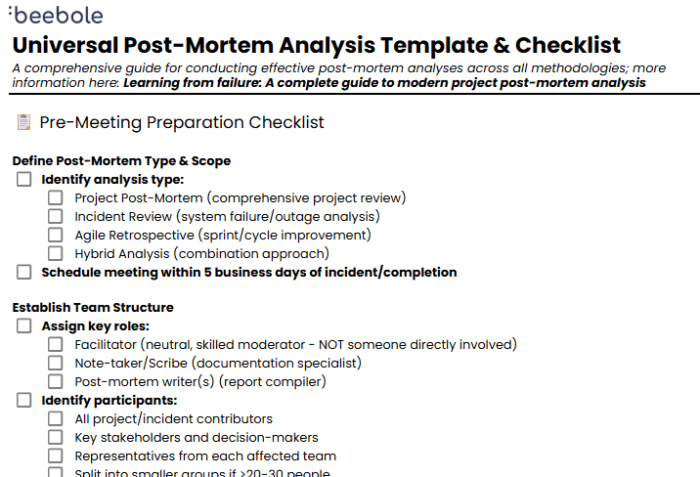
Conducting a project post-mortem analysis without project time tracking data in hand is guessing, not learning. Continue reading to learn why project time tracking data is essential when evaluating the success of a project, and be sure to download our free post-mortem analysis checklist below.
How have post-mortems evolved?
| Era | Focus | Implementation |
| 1940s–80s | Military-style after-action reviews | Only after major events |
| 1980s–90s | Root cause analysis & total quality | Episodic, not continuous |
| 2000s–today | Agile retrospectives, DevOps post-mortems | Continuous, integrated, cross-functional |
Modern post-mortems combine strategic review (project), operational learning (incidents), and team-level tuning (retrospectives).
What types of post-mortem reviews exist?
Post-mortem analyses can be referred to by various names, depending on the organization. You might see the ‘debriefs,’ ‘lessons learned,’ ‘after-action reviews,’ and ‘project wrap-ups’. Know that all of these refer to post-mortem reviews.
| Aspect | Project Post-Mortem | Incident Review | Agile Retrospective |
| Trigger | End of project/phase | Major outage or error | Every sprint |
| Duration | 2-4 hours | 1-2 hours | 30-90 minutes |
| Participants | Full project team + stakeholders | Incident responders + affected teams | Development team only |
| Frequency | Formal report | As needed | Every 1-4 weeks |
| Documentation | Strategic lessons | RCA document + action plan | Sprint notes + experiments |
| Focus | System reliability | Team dynamics |
How do these methods fit your project management style?
Post-mortem analysis with waterfall/PMBOK
Traditional project management follows a sequential “Waterfall” approach, where each phase must be completed before moving to the next. The most widely recognized framework is PMBOK (Project Management Body of Knowledge), created by the Project Management Institute (PMI).
PMI’s structured lessons learned process follows a systematic five-step approach:
- Identify lessons from project experiences
- Document findings in standardized formats
- Analyze root causes and implications
- Store insights in organizational process assets
- Retrieve knowledge for application to future projects
Post-mortems align with the “lessons learned” phase at project close. PMBOK recommends documenting and storing insights in organizational process assets for future reuse. Below, you’ll find a downloadable post-mortem checklist to help you and your team through analysis.
Post-mortem analysis with Agile/Scrum
Agile focuses on retrospectives after each sprint. While retrospectives fine-tune processes and communication, larger post-mortems are useful after major releases, high-stakes iterations, or failed experiments.
“The agile development method uses a brief post-mortem at the end of each short phase or “sprint” to improve the success of the next sprint”. Rather than examining major victories or failures, they concentrate on team collaboration during the previous cycle, asking “How can we improve our teamwork?” The outcome is a targeted action list for incremental improvements in the upcoming cycle.
Post-mortem analysis with hybrid/DevOps
This approach combines Agile retrospectives with incident reviews. DevOps culture utilizes post-mortems to bridge the gap between development and operations, enabling fast feedback and institutional learning.
Examples of how top companies run post-mortems
🧠 Google SRE
At Google, post-mortems are central to the Site Reliability Engineering (SRE) culture. They run blameless post-mortems within 48 hours of an incident, using a structured format that documents the timeline, impact, root causes, and action items with clear owners. The key takeaway: keep post-mortems fast, factual, and blame-free—and store them as training material so newcomers can run simulation exercises (like Google’s “Wheel of Misfortune”) to practice handling real failure scenarios before they happen in production.
🏠 J.M. Huber
J.M. Huber, a global manufacturing company, applies post-mortems in the form of After-Action Reviews (AARs). Huber runs these reviews after major projects or disruptions and stores them in a global database so every business unit can access and apply the lessons. The takeaway: don’t let insights sit in silos—centralize post-mortems and actively use them in future planning (even incentivizing the habit, as Huber does with its annual Chairman’s Award).
How to run a successful post-mortem (step-by-step)
1. Before the meeting
Start by assigning roles. A neutral facilitator helps keep the discussion balanced, while a scribe captures insights. Then, build a fact-based timeline using project documents, time tracking reports, logs, and chat history. With Beebole, you can quickly see where the team spent most of its time, when bottlenecks occurred, and how much effort and cost were invested in unexpected work. These insights remove guesswork and help participants enter the meeting with a shared understanding of what actually happened.
Send an agenda ahead of time. Include:
- Purpose of the meeting
- Timeline of events
- Key focus areas
It’s crucial that the facilitator establishes trust—this helps participants feel psychologically safe and ready to contribute.
2. During the meeting
Begin by reconstructing the story: What happened, when, and how. Avoid “why” questions early on—they can sound accusatory. Focus on factual sequence and team decisions.
Here’s a quick guide on productive questions to ask during a post-mortem meeting.
| If somebody: | That’s your cue to: |
| MAKES AN OBSERVATION: “It seemed a little off.” | ASK FOR CUES “What specifically made you think that it seemed off?” |
| MAKES AN ASSESSMENT: “It was broken.” | ASK ABOUT HOW THEY ARRIVED AT THAT “How could you tell? What did you first notice?” |
| MENTIONS A CHOICE: “So I decided to page the person on call.” | ASK ABOUT OPTIONS “What brought you to that decision? Have you ever done this before?” |
| SAYS, “I KNEW” “I knew I had to get it fixed.” | ASK HOW THEY KNEW IT “How did you know? Was this something you had been told? |
| REFERS TO A COMMON PRACTICE “Usually when I press this button, the machine turns on.” | ASK ABOUT WHAT NORMAL WORK LOOKS LIKE “Do you always turn on the machine that way? What usually happens next, or right before?” |
The key to discovering the story is asking good questions by focusing on “how” questions instead of “why” questions—you’re looking for descriptions, not explanations. While explanations tend to be reductive and defensive, descriptions provide the context you need for your timeline.
“Once you welcome people into the room and set expectations about the mindset they should be in (blameless) and the outcome (learning), there’s really only one thing to focus on: discovering the story behind the story. That is your north star,” according to the Etsy Debriefing Facilitation Guide.
Here are some common problem statement mistakes and fixes.
| Problem statement: | The fix: |
| Being too vague | ❌ “Our customers are unhappy.” ✅ “Customer satisfaction scores have dropped by 15% over the last quarter, primarily due to delayed responses from customer support.” |
| Focusing on symptoms instead of the root cause | ❌”Product reviews highlight frequent complaints about shipping delays.” ✅ “Shipping delays occur due to insufficient warehouse staff during peak seasons, resulting in negative product reviews.” |
| Ignoring the impact of the problem | ❌”The team isn’t meeting deadlines.” ✅”Missed project deadlines have resulted in a 20% decline in client satisfaction and delayed product launches, impacting revenue growth.” |
| Not defining clear goals | ❌”We’re not reaching our sales targets.” ✅”Sales have fallen 15% below targets due to ineffective lead generation strategies. Our goal is to regain momentum by increasing qualified leads by 20% within the next quarter.” |
Next, apply root cause analysis. At this step, looking at actual vs. estimated time analysis is crucial. Businesses need to understand where time estimates went wrong during the root cause analysis, and detailed, accurate time tracking data is essential for this exercise. Beebole’s resource planning tool, for example, gives teams a complete system for planning and assigning work. Planned time can then be checked against actual time tracked in Beebole using planned vs. real reports, which lay planned hours against actual hours in real time. With this information, teams can pinpoint exactly where an estimate diverged from reality instead of reconstructing it after the fact.
For simple failures, use the 5 Whys method. For more complex issues, tools such as the Fishbone (Ishikawa) Diagram or FMEA (Failure Mode and Effects Analysis) can help surface process flaws or systemic risks.
Finally, generate actionable recommendations in real time. Use a whiteboard or shared doc to record suggestions. Assign ownership to ensure follow-through.
3. After the meeting
Compile a post-mortem report that includes:
- The annotated timeline
- Key observations
- Root causes
- Agreed action items, with deadlines and owners
Distribute this report to all stakeholders and link to it in your project tracker or documentation hub.
Schedule a follow-up meeting or add a review checkpoint in your next sprint or planning cycle to assess progress on action items.
Success indicators: How to know if your project post-mortems are working
📈 Decreased repeat issues (track over 6 months): If the same problem stops appearing in tickets over 6 months, your post-mortems are fixing root causes—not symptoms.
📈 Faster incident resolution times: Time tracking data can provide objective proof that work is being done faster and more efficiently. Beebole’s custom report builder makes this easy to track over time — group and filter time entries by project, task, or date range, then save the report to a dashboard so you can compare resolution times before and after your post-mortem action items were implemented, instead of re-running the numbers manually each cycle. Export or share the report directly with stakeholders as proof the fixes worked.
📈 Higher team satisfaction scores: If survey results trend up, it’s a sign that a blameless, structured process is reducing stress and improving collaboration.
📈 Increased knowledge sharing between teams: When other teams reference past post-mortems before planning or responding to issues, your insights are spreading, not siloed.
📈 More proactive risk identification in planning: If teams flag risks earlier and build mitigation steps into plans, it shows past lessons are shaping future decisions.
Applying project post-mortem lessons to project planning and risk management
Lessons learned from past projects can significantly enhance your future project planning and risk management efforts. Here are some strategies.
- Apply lessons incrementally through retrospectives. Agile teams demonstrate effective integration by using retrospectives to “evaluate the team and create a plan to address areas of improvement for the future,” achieving continuous improvement in project outcomes.
- Treat past lessons as future risks. As Collier, DeMarco, and Fearey note, “lessons learned the hard way on past projects are, if nothing else, risks for future projects.” Add every lesson to your risk database and evaluate them on subsequent projects.
- Create a blameless learning environment. Instead of allocating blame, investigate why teams had incomplete or incorrect information—this enables effective prevention plans and encourages honest reporting.
- Populate risk registers with past insights. As project manager James Legatt explains, “One approach for risk assessment is to use project lessons learned to populate your risk register or guide brainstorming for future projects. Even specific lessons learned on one project can be generalized for any other project in its early stages.”
Best practices for making project post-mortem lessons learned actually useful
The ultimate goal is organizational process improvement through systematic learning. Here are some best practices for making project post-mortem lessons actually useful.
- Focus on what matters most. Prioritize lessons around the core issues that commonly derail projects, rather than creating an overwhelming database of scattered insights.
- Write actionable instructions, not warnings. Replace vague phrases like “be careful when…” with specific guidance: “check X and Y when doing Z task.”
- Organize by deliverable type. Link every lesson to specific types of deliverables (time plans, budgets, risk responses) so teams can easily retrieve all relevant lessons when working on particular tasks.
- Actually use the lessons—don’t just store them. Create a checklist for each type of deliverable (time-plan checklist, budget checklist, risk-response plan checklist) and embed your lessons directly into these working tools.
Download now: A post-mortem checklist to use now
Our checklist walks you through the steps to take before, during, and after a project post-mortem, including success metrics and quality indicators.

Key takeaways: What you need to know about post-mortems
- Post-mortems work best when they are blameless and action-oriented
- Use the right approach for the situation: project review, incident analysis, or sprint retrospective
- Avoid vague advice—capture clear actions with responsible owners
- Embed insights into templates, checklists, and knowledge systems
- Organizations that learn from failure build resilience and competitive advantage
FAQ: Project post-mortems
When should I run a project post-mortem?
As soon as possible after a project phase ends or an incident is resolved. Don’t wait too long.
What are the best questions to ask in project post-mortems?
Use “how” questions; here are some examples:
- How did this decision get made?
- How did the issue escalate?
- What signals did we miss?
- How did we make critical decisions, and were those processes effective?
- How can we better support each other as a team?
- How did we track progress during the project?
Are sprint retrospectives enough?
Not always. Use retros for team habits; use post-mortems for bigger-picture project or system learnings.
How do we stop finger-pointing?
Set a blameless tone. Focus on process and systems, not people. Transparency and curiosity should drive the conversation.
Credible sources to learn more about project post-mortems
- Google SRE Book: Post-mortem Culture
- Harvard Business Review on After-Action Reviews
- Wharton on After-Action Reviews
- Etsy’s Debriefing Facilitation Guide
- Quality-One International on Root Cause Analysis
The experts who have written or contributed to this article are independent from Beebole, and their contribution doesn't serve as endorsement for our company/tool or their past/present organizations, employers, or associates.

Writer specialized in finance, tech and SaaS. Apart from writing, he loves football and cultural walks around Rome.
Related posts
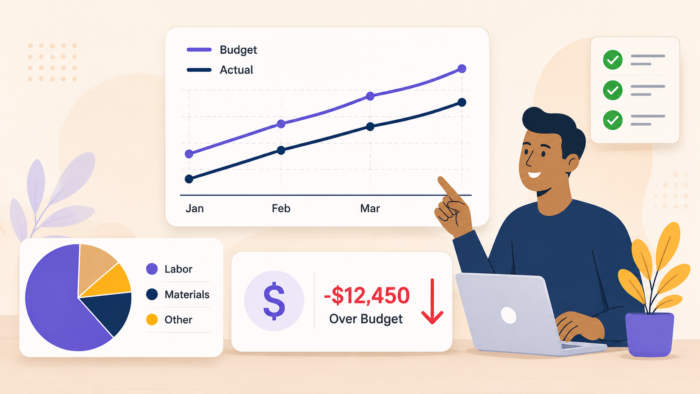
Project cost control made easy: Mastering budget-to-actual variance analysis
To deliver a product or service within a specified time and budget, you have to juggle a variety of activities, responsibilities, and stakeholders. Estimating the project’s cost and keeping tabs on actual spending are two crucial aspects for project managers. Budget-to-actual variance analysis is the comparison of the budgeted and the actual cost of the […]

How to report absenteeism KPIs with an executive HR dashboard
Absenteeism KPIs are a crucial piece of executive HR dashboards because they shed light on trends and potential issues. Employees miss work from time to time due to different reasons, including being sick or even unplanned absences, and that’s how it should be. It’s unrealistic to expect them to report to work every day of […]

How to use Power BI for planning, budgeting, and forecasting
Is your organization stuck in spreadsheet chaos because your teams use unnecessarily complicated planning, budgeting, and forecasting tools? For example, when it comes to business budgeting, planning, and forecasting, many top-tier companies still rely on “the good old” Excel or some similar specialized planning tools like SAP BPC, Hyperion, or Workday Adaptive. Nevertheless, do you […]